

Ecomonic Modeling
Economic modelling uses simplified representations of the economy to understand how people, firms, markets, and policies interact. At its core, it turns complex real-world behavior into a system that can be analyzed, tested, and used for counterfactual analysis. The discipline is vast and covers a range of modeling approaches, including analytical, statistical, and deterministic.
Our research group specializes in the use of Computable General Equilibrium (CGE) models. CGE models are deterministic or structural, quasi‑empirical models grounded in observed economic data and microeconomic theory. Rather than estimating causal relationships, they simulate alternative equilibria to explore how economies might respond to policy changes or external shocks. Their strengths lie in capturing the interconnections between agents (consumers and producers), sectors (e.g., energy and agriculture), markets (e.g., factors and commodities), and regions via trade.
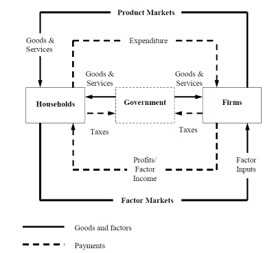
Building on the circular flow of the economy (Figure 1) and general equilibrium theory, CGE models assess both direct and indirect welfare effects in ex‑ante policy analysis. In other words, they allow researchers to simulate the potential impacts of alternative policy options before implementation and to compare their implications for overall wellbeing, including economic, social, and environmental dimensions, to support evidence‑based policymaking.
Figure 1: The circular flow of the economy (Wing, 2004)
Projekte
Models
Quick Links
Social Media