Über uns

Pflanzen beherbergen eine artenreiche Mikrobiota mit einer Vielzahl von Bakterien, Pilzen oder Oomyzeten und stehen in ständiger Interaktion mit diesen. Diese Mikroorganismen fungieren kollektiv als Mikrobiom und beeinflussen, ähnlich wie die mikrobiellen Gemeinschaften im menschlichen oder tierischen Darm, die Ernährung und Gesundheit ihres Wirtes. So können beispielsweise Mitglieder der Pflanzenmikrobiota die Nährstoffaufnahme verbessern oder den Schutz vor Krankheitserregern gewährleisten. In unserer Forschung befassen wir uns mit den folgenden grundlegenden Fragen der Biologie von Pflanzenmikrobiomen:

- Wie kommunizieren Pflanzen mit der Wurzelmikrobiota und nehmen Einfluss auf deren Aktivitäten?

- Was ist der funktionelle Beitrag der Wurzelmikrobiota zum Pflanzenwachstum und zum Krankheitsschutz?

Ziel unserer Forschung ist letztlich, dass nützliche Interaktionen zwischen Pflanzen und Mikroorganismen in einer intelligenten und nachhaltigen Landwirtschaft eingesetzt werden können. Wir arbeiten hauptsächlich mit Arabidopsis thaliana und Zea mays als Modellpflanzen und kombinieren Feld- und Laborexperimente mit Methoden der Mikrobiomik, Molekularbiologie, Mikrobiologie, Pflanzengenetik und Bioinformatik.
 

Adresse

Universität Basel
Departement Umweltwissenschaften
Pflanzen Mikroben Interaktionen
Bernoullistrasse 32
CH-4056 Basel

News
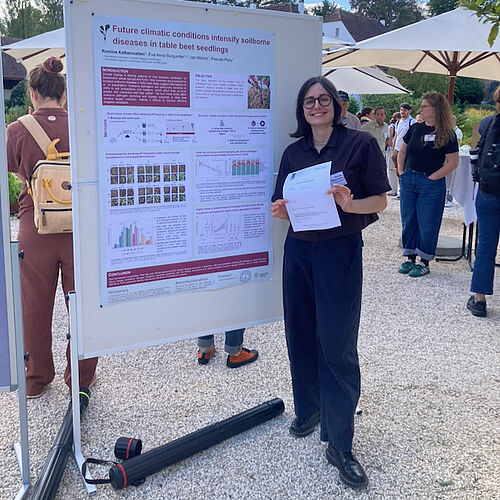
Congratulations Dr. Anja!

Congratulations Dr. Anja!

05.02.2026
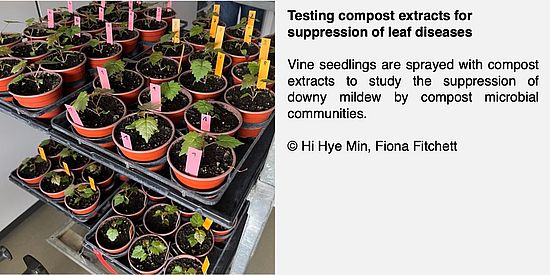
On 5 February 2026, Anja Logo successfully defended her PhD thesis. In her research, Anja investigated the disease-suppressive properties of composts and identified key microbial taxa associated with disease suppression. In an extensive isolation effort she further established a comprehensive collection of compost-derived microbes and studied their disease suppressive activity in synthetic communities. Her work presents an important contribution towards a better understanding of disease-suppressive composts and provides a strong foundation for future mechanistic studies. Anja’s PhD was embedded in a large collaborative project involving FiBL, Agroscope, ETH Zurich, and the University of Basel. She was therefore co-supervised by Dr. Pascale Flury (University of Basel), Dr. Johanna Mayerhofer (Agroscope) and Prof. Monika Maurhofer (ETH Zurich).
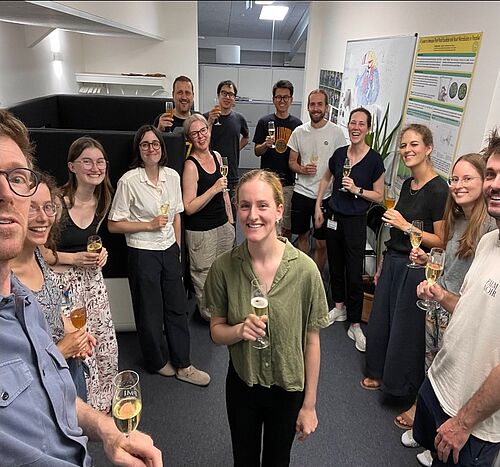
Anja, you did a great job! Congratulations! And, thank you very much for the great Apéro after your defense. We had a wonderful time celebrating you and the completion of the project together!

Congratulations Dr. Katja!

Congratulations Dr. Katja!

25.09.2025
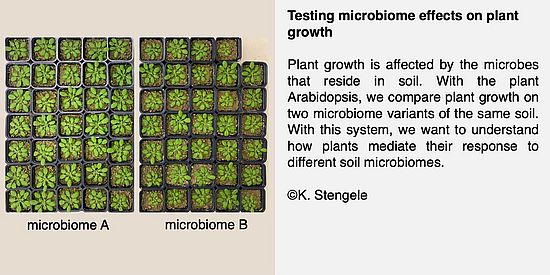
Katja Stengele successfully defended her PhD thesis. She investigated how plants respond to different soil microbiomes, i.e. how plants mediated microbial feedbacks on growth, development and/or defence. Katja established an experimental system with two soil microbiome variants allowing to study their differential feedbacks on the model plant Arabidopsis. While benefical soil microbiome enhanced growth and primed for better defence, this was not seen for the non-beneficial soil microbiome. Katja identified conserved plant transcription factors that mediate the beneficial microbiome feedbacks on Arabidopsis growth and defence. Rational thinking, logic, commitment and talent >>> very good PhD; congratulations Katja!

Congratulations Dr. Charlotte!

Congratulations Dr. Charlotte!

18.09.2025
Charlotte Joller successfully defended her PhD thesis. To investigate the cry-for-help hypothesis, she developed a glass-bead based jar system allowing the dynamic analysis of root exudates and root bacterial community assembly. With this jar system, Dr. Jarlotte could show that plants with upregulated immunity secrete a specific cocktail of compounds to the surrounding media – yes, plants cry. The surprising finding was that commensal bacterial communities suppressed the immune-stimulated exudation cocktail – they make the plant to shut up. Coolness, commitment and talent > very good PhD; congratulations Charlotte!

Nach oben