

Geothermal potential of Alpine aquifers - Pilot study Brig, Canton Valais
The research project "Geothermal potentials of alpine aquifers - pilot study Brig, Canton Valais" aims to close knowledge gaps in the hydrogeological process understanding of geothermal systems at the regional level. To this end, the methodology developed by AUG for evaluating regional groundwater circulation systems is combined with heat transport (temperature distribution and heat potentials) and applied to the Brig case study. On the one hand, an instrument will be developed for the authorities. Another objective is the development and application of monitoring and model instruments (Figure), which can be used to estimate the geothermal utilization potential of the Alpine aquifer in the Brig region. The transferability of the developed methods to other Alpine valleys will be examined in order to avoid future quantitative and thermal overuse of the groundwater systems.
Commissioned by: Canton of Valais, energieschweiz
Project duration: 2021-2024
Stefan Scheidler, Horst Dresmann, Oliver Schilling & Jannis Epting
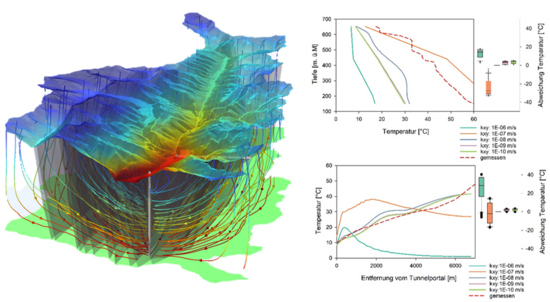
Figure: Left: Calculated groundwater circulation and temperature distribution. Right: Sensitivity analysis for hydraulic conductivity values for borehole 10-BR02 and the Simplon tunnel.
3D-Thermohydraulic Modelling of Geologically Complex Alpine Systems: Insights for Geothermal Resources Exploration from Simulating the Upper Aarmassif, Switzerland
Mountainous regions such as Switzerland, which are characterized by highly complex geological and hydrogeological conditions, hold significant geothermal potential linked to tectonic settings and deep hydrothermal flow systems. However, geothermal exploration in such regions is challenged by geological and hydrogeological complexity, data scarcity, high uncertainty, administrative hurdles, as well as environmental and economic risks associated with drilling. Robust quantitative tools that maximize the value of the limited information available on the subsurface are needed to assess geothermal potential, productivity, and sustainability.
Here, a step-by-step framework for the assessment of regional hydrothermal flow systems is presented. The framework consists of 3D geological modeling, 3D thermohydraulic modelling and a systematic sensitivity analysis for the identification of the optimal structural model complexity. The framework is demonstrated on the hydrothermal systems of the Upper Aarmassif in the Swiss Alps.
Results showed that thermal upwelling in the system is driven by strong topographic gradients and upward flux along more permeable tectonic faults and thrusts (Figure). The upwelling results in significantly elevated groundwater temperatures near the surface in the Rhone Valley, with temperatures exceeding 70 °C at depths of 1000 m and reaching ~100 °C at depths of 2’000 m. These model outputs were verified by the few available vertical borehole temperature profiles, horizontal tunnel temperature profiles, groundwater recharge rates and hydraulic head distribution, 14C-based groundwater residence times and geothermometrically identified hydrothermal-reservoir- temperature estimates. The framework provides the basis for risk-reduced geothermal exploration, thereby supporting sustainable geothermal development- a significant step towards a decarbonized energy future.
Commissioned by: Canton of Valais, energieschweiz
Project duration: 2021-2024
Stefan Scheidler, Michel Walde, Eric Zechner, Oliver Schilling & Jannis Epting
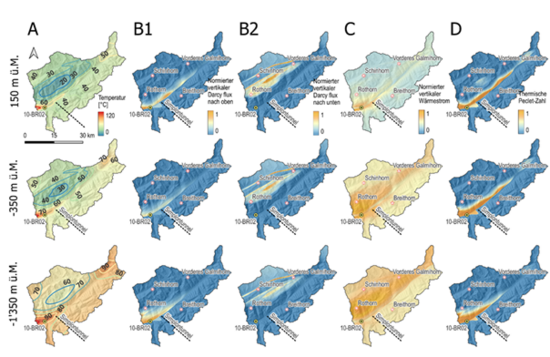
Figure: For altitudes of 150, 350 and 1350 m asl (base map: swissALTI3D monodirectional slope shadow): Temperature distribution (A); Vertical groundwater flow (Darcy flow) upwards (B1) and downwards (B2); Normalized vertical heat flow (C); Thermal Peclet number (D).
Further publications:
Scheidler S, Christe PG, Zechner E, Walde MA, Schilling OS, Epting J (2025): Thermohydraulische 3D-Modellierung im alpinen Raum – Erschliessung geothermischer Potenziale im Oberwallis (Pilotprojekt Brig). Zeitschrift Wasser Energie Luft Heft 3 (117), 135–141
Scheidler S, Christe PG, Zechner E, Walde MA, Schilling OS, Epting J (2025): Geothermie im alpinen Raum: Potenziale & Grundwasserschutz: Werkzeuge zur Erschliessung geothermischer Potenziale im Kanton Wallis - Pilotstudie Brig, AQUA & GAS No. 12
Quick Links
Social Media