

Future river temperatures under the influence of climate change
The effects of climate change on Swiss water bodies, including the impact on river temperatures and discharge, can already be observed today. As part of the research project "Future river temperatures in Switzerland under climate change - SwissFuRiTe[1]", nationwide projections of future river temperatures were simulated for all 82 river monitoring stations of the Federal Office for the Environment (FOEN) (Figure 1).
For this purpose, we chose a novel modeling approach that combines air temperatures from 22 general circulation and regional climate models (GCM-RCM) and runoff projections from 4 hydrological models as input for 2 semi-empirical surface temperature models. With these models, future projections of river water temperatures could be simulated for the 3 climate emission scenarios (RCP2.6, RCP4.6 & RCP8.5).
The river monitoring stations were grouped and the results analyzed according to thermal regimes (lake, Central Plateau/Jura, Alpine, regulated and springs), which are influenced by different thermal processes upstream (Figure 1).
The surface temperature models air2stream[2] (rivers) and air2water[3] (lakes) were used to determine which of the two models is better suited to the settings of the respective river monitoring stations. While air2stream was used at all sites, the air2water model was used at sites where the influence of lake water upstream dominated the temperature signal in the rivers.
The study showed that the most important factor for the level of temperature increase by the end of the 21st century is the climate emission scenarios (Figure 2). For the RCP2.6 scenario, the mean change in river water temperature from the reference period (1990 to 2019) to the near (2030 to 2059) and distant future (2070 to 2099) is 0.8 and 0.9 °C respectively. The largest temperature increase can be observed for the RCP8.5 scenario, in which the mean river water temperature rises by 1.2 and 3.1 °C for all stations in the near and distant future. The rate of warming differs for each station depending on the upstream processes. In addition, the seasonal trends in air temperature and discharge amplify the warming of watercourses in summer as a result of higher air temperatures and lower discharge volumes. While the increase in runoff and the lower warming of the atmosphere in winter also lead to a lower warming of the watercourses.
An analysis of thermal threshold and extreme values shows that heatwaves in Switzerland are likely to increase in the future. On the basis of our study, we were able to identify particularly vulnerable river sections, both those that are already at risk today and those that will be at risk in the future.
Future studies should focus on counteracting the local negative effects of climate change. The results of our study can be used to identify river sections with increased vulnerability and to designate targeted refugia for aquatic organisms.
[1] Bundesamt für Umwelt (CH) BAFU-Projekt „Zukünftige Flusstemperaturen in der Schweiz unter dem Einfluss des Klimawandels“ 22.0007.PJ / 5C2F04B23 (04.2022 – 07.2023)
[2] Toffolon M & Piccolroaz S (2015) A hybrid model for river water temperature as a function of air temperature and discharge. Environ. Res. Lett. 10, 114011
[3] Piccolroaz S, Toffolon M & Majone B (2013) A simple lumped model to convert air temperature into surface water temperature in lakes. Hydrol. Earth Syst. Sci. 17, 3323–3338
Commissioned by: Federal Office for the Environment (FOEN)
Project duration: 2022 – 2023
Love Råman Vinnå, Oliver Schilling & Jannis Epting
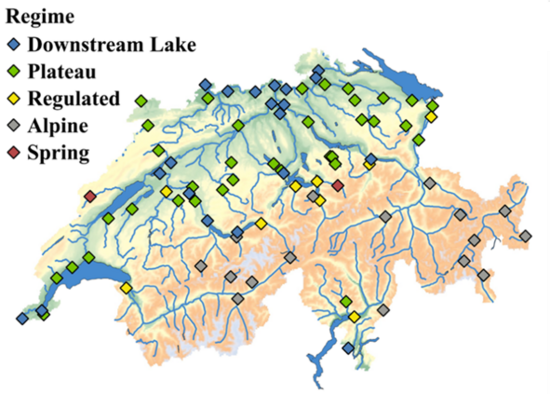
Figure 1: Thermal regimes of rivers at FOEN stations.
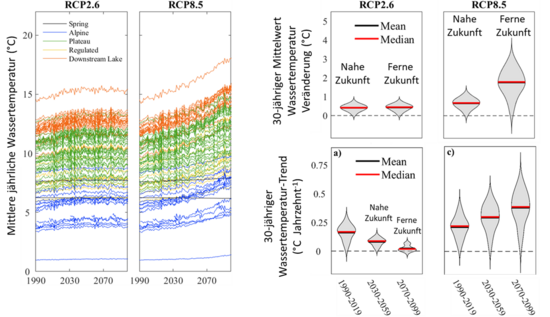
Figure 2: Left: Modeled annual mean water temperature of the 82 river monitoring stations for the climate scenarios RCP2.6 and RCP8.5. Shown are projections of up to 23 coupled GCM-RCM climate models and 4 hydrological flow models after applying a trend bias correction. The fluxes are sorted according to the thermal regime. Right: Violin plots of the statistics and development of water temperatures in the near and distant future.
Future River Temperatures Under the Influence of Climate Change – SwissFuRiTe
The effects of climate change on Swiss waters, including the impact on river temperatures and discharge, can already be observed today. As part of the research project "Future river temperatures in Switzerland under climate change – SwissFuRiTe", nationwide projections of future river temperatures were simulated for all 82 river measuring stations of the Federal Office for the Environment (FOEN).
Future water temperatures in Swiss rivers were projected using a multi-fidelity modelling approach. To this end, we used two different semi-empirical models for surface water temperature, 22 coupled and downscaled general circulation and regional climate models, future projections of river discharges from four hydrological models, and three climate change scenarios (RCP2.6, 4.5 and 8.5). By grouping river sections, catchment areas and spring-fed watercourses under representative thermal regimes and applying hierarchical cluster-based thermal pattern recognition, an optimal model and model configuration were automatically selected, model performance was optimized and the estimation of the effects of climate change on river water temperatures was improved.
The results show that the average water temperatures of rivers in Switzerland are likely to rise by 3.1+/-0.7 °C (or 0.36+/-0.1 °C per decade) by the end of the 21st century under RCP8.5, while under RCP2.6 the temperature increase could remain at 0.9+/-0.3 °C (0.12+/-0.1 °C per decade). Under RCP8.5, the temperatures of rivers associated with the Alpine heat regime will rise the most, namely by 3.5+/-0.5 °C, followed by rivers in the regime below lakes, which will rise by 3.4+/-0.5 °C.
A general decline in runoff in summer (-10 to -40%) and an increase in winter (+10 to +30%), combined with a further increase in average near-surface air temperatures (0.5 °C per decade), may not only lead to warmer rivers overall, but also to longer periods of extreme summer river water temperatures.
Finally, a classification of hysteresis loops revealed that global warming stretches most thermal hysteresis loops diagonally upwards to the left (Figure: Example BAFU measuring station Thur – 2044). This stretching trend results from the general decrease in runoff and the increased seasonal near-surface air temperature and water warming in the summer months; together, these two processes increase the water temperature of flowing waters even in summer.
This drastically increases the thermal stress potential for temperature-sensitive aquatic animals such as brown trout. Increasingly frequent stress phases affect not only rivers where such situations have already been observed, but also rivers that have not had any problems to date. By providing information about future water temperatures, the results of this study can serve as a guide for management measures to combat climate change.
Commissioned by: Federal Office for the Environment (FOEN)
Project duration: 2022 – 2024
Love Råman Vinnå, Oliver Schilling & Jannis Epting
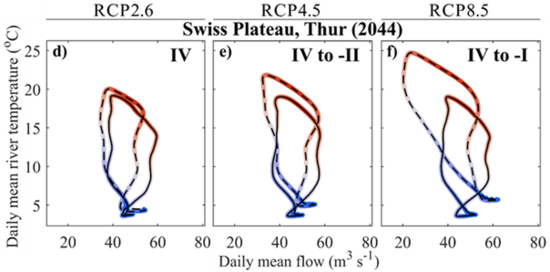
Figure: Current and future thermal hysteresis loops: Daily average discharges and water temperatures for the FOEN measuring station Thur (2044) and the reference period (1990 to 2019, solid line) as well as the distant future period (2070 to 2099, dashed line). The station belongs to the "Swiss Plateau" thermal regime. The daily average data sets were smoothed twice with a running average of 30 days.
Further publications:
Råman Vinnå L, Bigler V, Schilling OS, Epting J (2025): Klimawandel und steigende Wassertemperaturen in Schweizer Fliessgewässern: Ein zunehmender Stressfaktor für Kaltwasserfische. Zeitschrift Wasser Energie Luft Heft 1 (117), 19–14
Råman Vinnå L, Bigler V, Schilling OS, Epting J (2025): Zukünftige Fliessgewässertemperaturen – Simulation schweizweiter Projektionen der steigenden Temperaturen in Fliessgewässern. AQUA & GAS No. 17+8, 58-66; https://www.aquaetgas.ch/wasser/gew%C3%A4sser/20250707-ag7-8-simulation-fliessgew%C3%A4ssertemperaturen/
Quick Links
Social Media